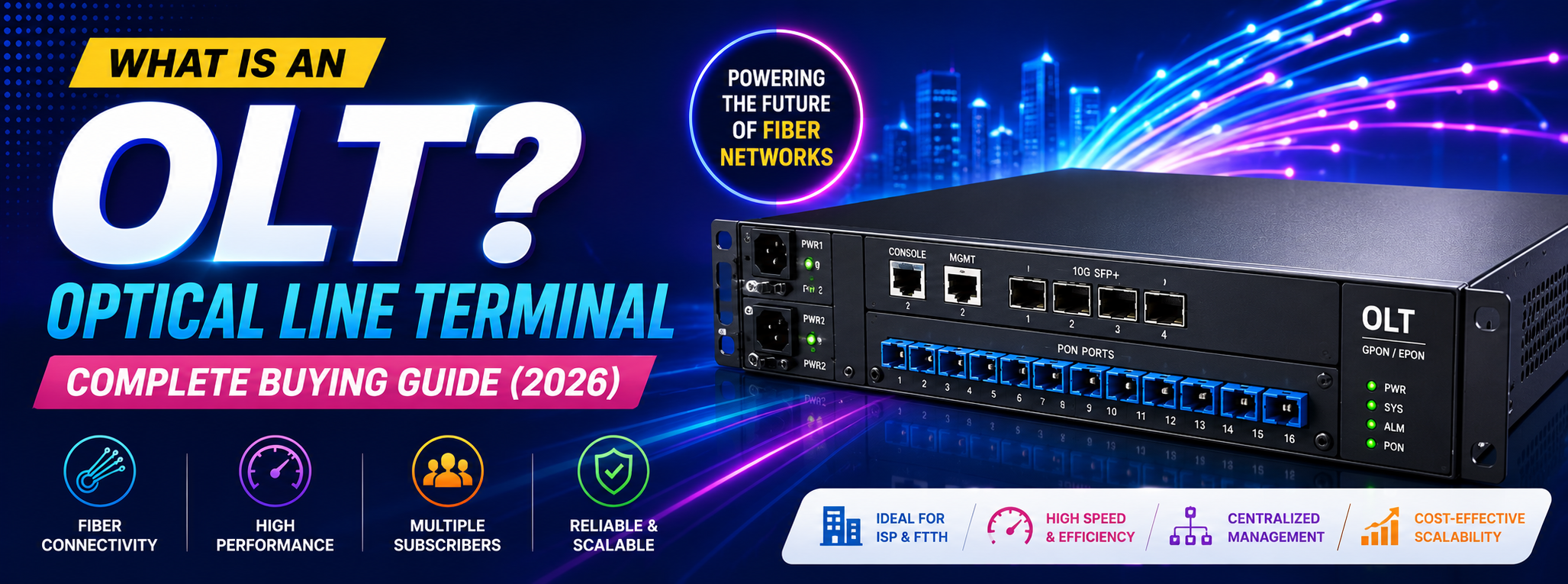
As Fiber-to-the-Home (FTTH) and Fiber-to-the-Business (FTTB) deployments continue to grow, Optical Line Terminal (OLT) devices have become the backbone of modern fiber optic communication. Internet Service Providers (ISPs), telecom operators, enterprises, and large organizations rely on OLT technology to deliver high-speed internet, voice, and IPTV services over a single fiber infrastructure.
If you're planning to build or expand a GPON or EPON network, understanding how an Optical Line Terminal works is essential. In this guide, we'll explain everything you need to know about OLT devices, their features, benefits, applications, and how to choose the right OLT for your network.
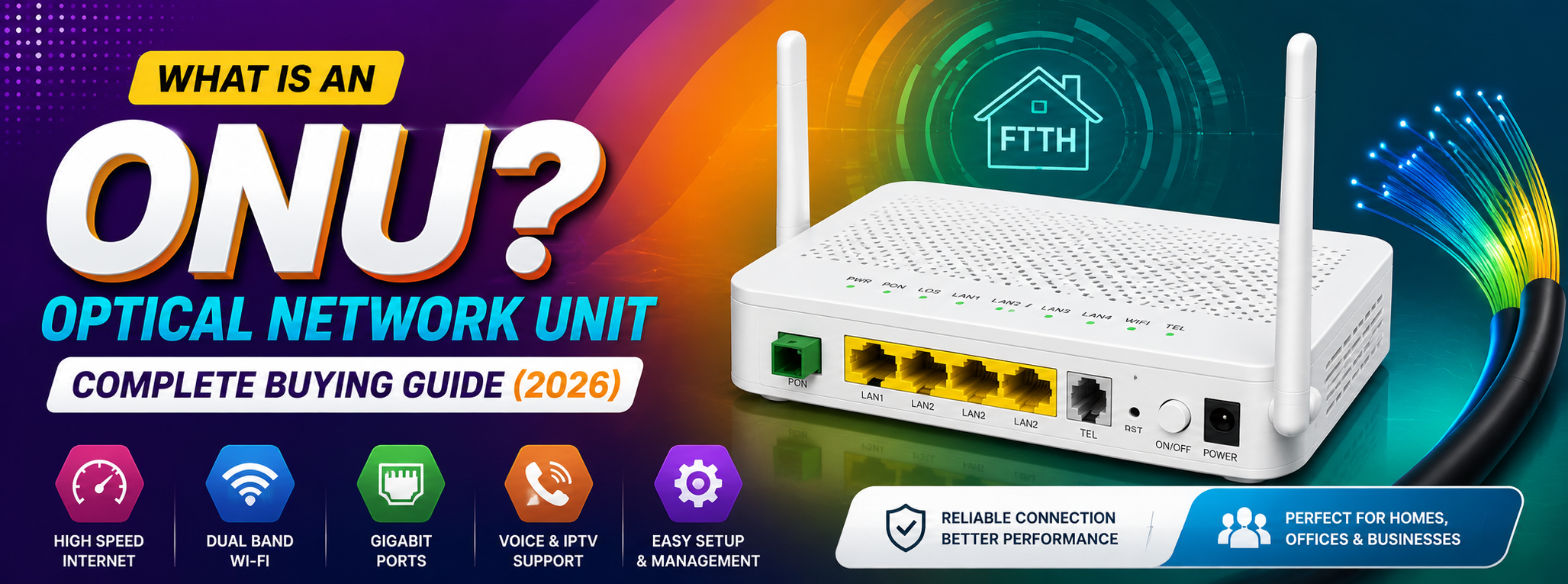
An Optical Line Terminal (OLT) is the central networking device used in Passive Optical Networks (PON). It is installed at the service provider's central office or data center and acts as the main communication point between the ISP and multiple Optical Network Units (ONUs) or Optical Network Terminals (ONTs).
The OLT transmits internet, voice, and television services over fiber optic cables to end users while managing bandwidth, authentication, and network performance.
An OLT receives data from the ISP's core network and converts it into optical signals. These signals travel through fiber optic cables to optical splitters, which distribute the connection to multiple ONUs or ONTs at customer locations.
The OLT also receives upstream traffic from users, manages bandwidth allocation, and ensures stable communication across the entire fiber network.
Supports Gigabit fiber communication for homes, businesses, and enterprise customers.
A single OLT can serve dozens or even hundreds of ONUs depending on the model and splitter ratio.
Network administrators can monitor connected devices, manage bandwidth, configure VLANs, and troubleshoot issues from a single platform.
Additional subscribers can be connected without redesigning the entire fiber network.
| Feature | GPON OLT | EPON OLT |
|---|---|---|
| Download Speed | Up to 2.5 Gbps | Up to 1.25 Gbps |
| Upload Speed | Up to 1.25 Gbps | Up to 1.25 Gbps |
| Efficiency | Higher | Good |
| Typical Use | Enterprise & ISP | ISP & Small Networks |
Choose an OLT based on the number of subscribers you plan to support now and in the future.
Ensure the uplink ports provide enough bandwidth to handle peak traffic.
Look for VLAN, QoS, SNMP, CLI, and web-based management features for easier administration.
Verify compatibility with your existing ONU/ONT devices to ensure smooth deployment.
An OLT serves as the central device that distributes fiber internet services to multiple ONUs or ONTs in a Passive Optical Network.
Yes. Depending on the model and splitter configuration, one OLT can support dozens or even hundreds of subscribers.
The OLT is installed at the service provider's central office, while the ONU or ONT is installed at the customer's location to receive fiber services.
An Optical Line Terminal (OLT) is the foundation of modern GPON and EPON fiber networks. It enables ISPs and enterprises to deliver high-speed internet, voice, and IPTV services efficiently while supporting scalable, reliable, and cost-effective network expansion. Choosing the right OLT ensures better performance, easier management, and long-term network growth.
For genuine OLT devices, GPON solutions, SFP modules, networking equipment, and expert technical support, South Bangla Computers provides reliable products from trusted global brands.